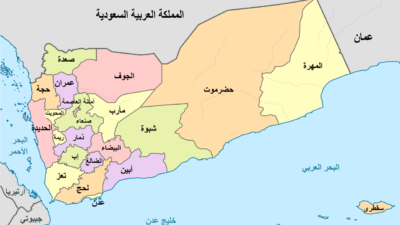
This report examines the repercussions of the Houthis’ control of the Yemeni city and port of Al-Mokha.
The historic port is closely associated with the global coffee trade. Today, however, its importance goes far beyond coffee. Its location raises concerns about global energy security and international trade routes.
Control of Al-Mokha could potentially give the Houthis greater leverage over the Bab al-Mandab Strait. The group also controls Perim Island, which is located in the middle of the strait.
Bab al-Mandab is one of the world’s most important maritime routes. It is a key gateway for international energy trade and oil shipments.
The situation could have wider consequences for Saudi Arabia.
If Saudi ships and oil tankers are prevented from passing through Bab al-Mandab, Riyadh would have fewer options for exporting its oil. One alternative is the Suez Canal, using pipelines that transport oil from eastern Saudi Arabia to the western part of the kingdom.
However, these routes face growing security concerns.
Recent attacks targeting oil pipelines have raised questions about the safety and availability of these alternative routes. As a result, Saudi oil giant Aramco reportedly cancelled a number of oil shipments bound for European markets.
The impact does not stop at Saudi Arabia.
Major Asian economies, particularly India, China and Pakistan, are also heavily dependent on the Bab al-Mandab route. According to the report, these countries import around 36% of their oil requirements through the strait.
Therefore, any prolonged disruption could affect energy supplies well beyond the region.
The situation also raises questions about the recently announced regional agreement between Pakistan, Türkiye and Saudi Arabia.
Could the agreement be activated in response to threats of this scale?
According to the report, however, the agreement was designed primarily for strategic deterrence, rather than as a mechanism for responding to disruptions in oil supplies.
Meanwhile, the effects are already being felt in global energy markets.
Fuel and petroleum product prices continue to rise amid the escalating tensions. At the same time, reports from the International Energy Agency indicate that global oil inventories have fallen by more than 500 million barrels since the outbreak of recent conflicts and wars in the region.
As a result, continued disruption around Bab al-Mandab could create further pressure on global energy markets.
It could also lead to wider economic and energy-related complications in the near future.