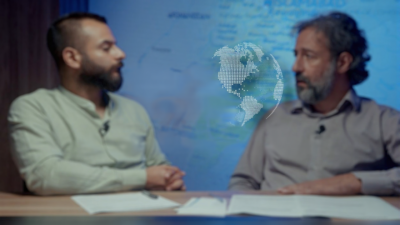
The latest episode of “Kharita Wadha” examined Turkey’s growing regional and international role.
The episode featured researcher and political writer Gil Samaaha, who explored the historical roots and geopolitical factors that have reshaped Turkey’s position as a major middle power in the contemporary world.
The discussion began with Turkey’s unique geographic position.
Turkey has historically served as a natural link between East and West, as well as between North and South. It also controls vital land and maritime routes through its strategic straits, particularly the Bosphorus and the Dardanelles, which connect the Black Sea to the eastern Mediterranean.
The country’s geography also provides significant natural advantages, including mountainous terrain and diverse climates.
Another important factor is Turkey’s population, which stands at around 90 million people. This has provided the country with a substantial human and economic base across different historical periods.
The discussion also examined Turkey’s transformation from a multi-ethnic empire under the Ottoman Empire into a modern national state with a secular character, established along contemporary lines in the early 1920s.
At the same time, Turkey retained much of its long administrative and military experience in managing strategic routes and trade networks.
The episode then explored the foundations of Turkey’s domestic power.
For decades, particularly from the 1920s through the 1970s, the Turkish state focused on building its institutions and developing a diversified and productive economy.
It also invested heavily in transportation infrastructure, including major road networks and airports.
Alongside these efforts, Turkey developed increasingly independent military and industrial capabilities.
This became particularly visible in sectors such as Bayraktar drones and domestically produced tanks.
Turkey also expanded its major construction companies and developed a large tourism sector, which became an important part of the national economy.
According to Samaaha, Turkey’s strategic outlook began to change as its prospects for joining the European Union became increasingly limited.
At the same time, direct American influence declined following the end of the Cold War.
These developments encouraged Turkey to redirect its strategic focus toward the region and the wider international arena.
Its membership in NATO also provided Turkey with an important strategic position, while it maintained relationships with countries including Russia, Ukraine and China.
The discussion also examined Turkey’s growing regional role.
One example was the emergence of new strategic partnerships, including the trilateral cooperation agreement between Turkey, Pakistan and Saudi Arabia.
The episode presented these relationships as potential balancing arrangements in which economic and military interests overlap.
The discussion also considered how Turkey’s growing influence and overlapping spheres of influence could affect neighboring countries, particularly Syria and Lebanon.
The episode concluded by examining the challenges that could shape Turkey’s future international role.
According to the analysis, Turkey’s ability to maintain and expand its external influence will depend partly on the stability of its domestic political and economic environment.
Key challenges include the Kurdish issue, structural inflation and broader economic pressures.
At the same time, changes in the international balance of power will continue to influence Turkey’s strategic choices and its role in the region and beyond.